9787 SW 72nd St, Miami · Open Mon–Fri 8:30 am–6:00 pm · Free same-day Miami-Dade delivery
Brazilian Butt Lift · Miami

BBL post-op medications, filled before your surgery date.

What your surgeon prescribes, and why a BBL is different.

A BBL asks more of your medication plan than most procedures — you can't sit normally, you're moving less, and the grafted fat needs a clean, low-pressure environment to survive. Here's what surgeons typically prescribe, when each piece starts, and how to have all of it waiting for you instead of filled while you're in recovery.
Filled before surgery day Discreet recovery-house delivery Pharmacist check-in calls
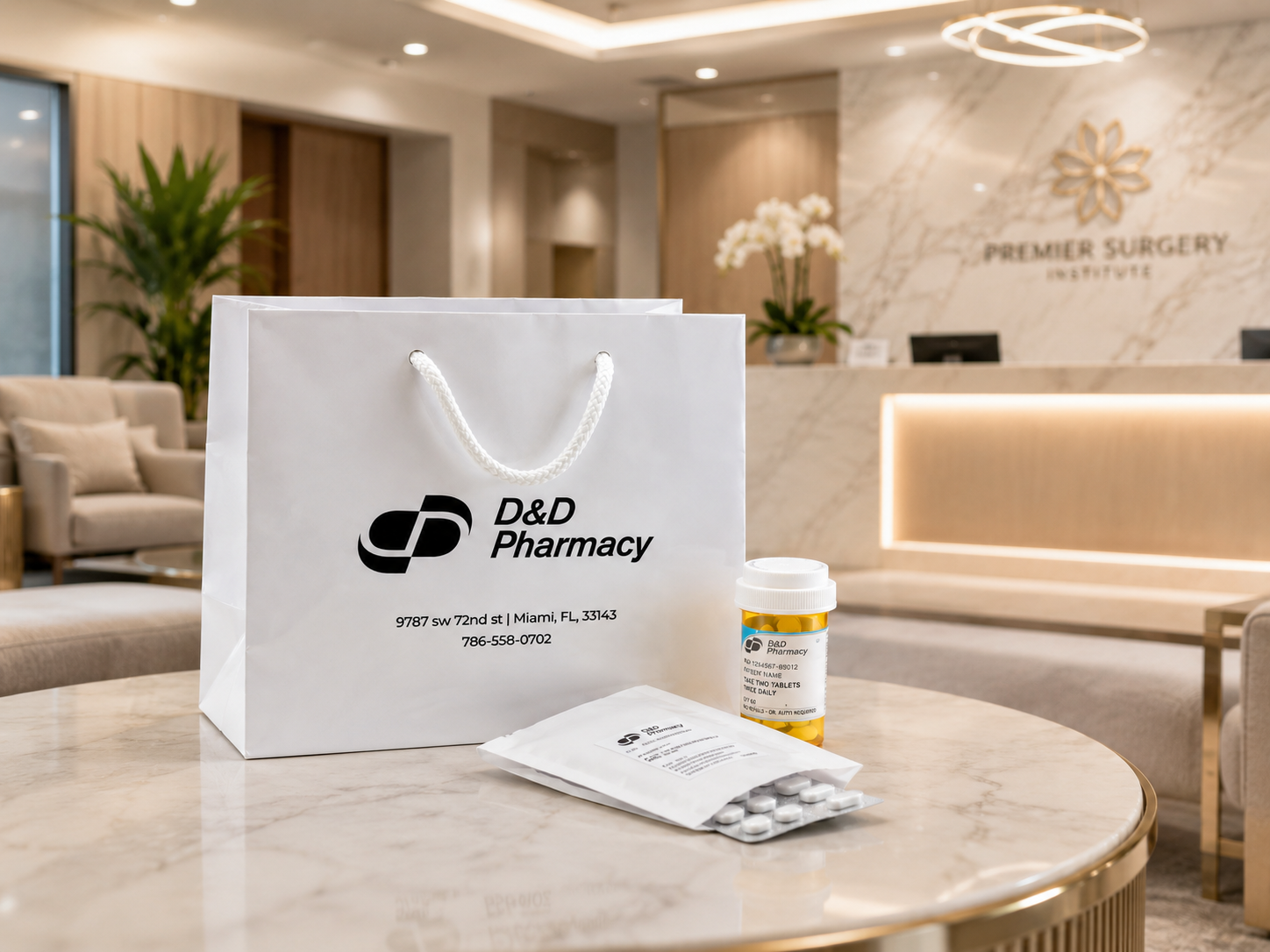
BBL post-operative medications prepared for delivery by D&D Pharmacy in Miami
The short answer

What medications do you take after a BBL?

Most BBL recovery plans include five things: an antibiotic to prevent infection around the grafted fat, an anti-nausea medication for the hours after anesthesia, aggressive constipation prevention with a stool softener and laxative, a short course of prescription pain medication alongside non-narcotic options, and silicone-based scar care once the incisions have closed. An antiseptic wash is usually started the night before surgery.

Your surgeon writes the actual list. What follows is what those categories do, why the BBL version differs from other procedures, and where patients most often get caught out.

Category by category

What each medication is actually doing.

Antiseptic wash

Skin preparation

Lowering skin bacteria at the donor and injection sites before incision. Usually the night before and the morning of surgery.

Chlorhexidine gluconateHibiclens
Antibiotics

Infection prevention

Fat grafting creates a large area of transferred tissue with a fragile early blood supply. The full course matters even once you feel fine.

CephalexinAmoxicillin-clavulanateBactrim DS
Anti-nausea

Nausea prevention

Beyond anesthesia recovery: vomiting means abdominal straining, which is exactly what you're avoiding after liposuction of the flanks and abdomen.

OndansetronScopolamine patchPromethazine
Stool softeners

Constipation prevention

The one patients underestimate. Opioids slow the gut, you're walking less, and straining puts pressure through the exact area that needs to be left alone. Start day one.

Docusate sodiumPolyethylene glycolSenna
Pain management

Comfort & mobility

The donor sites — abdomen, flanks, back — usually hurt more than the grafted area. Most surgeons taper the prescription portion within the first week.

AcetaminophenShort prescription courseMuscle relaxant
Scar care

Scar management

For the small liposuction access incisions. Started only after incisions are fully closed and cleared by your surgeon, then continued for months.

Silicone gelSilicone sheets
Supportive care

Swelling & bruising

Added by some surgeons for bruising and swelling. Take these only if your surgeon has approved them — several supplements affect bleeding.

ArnicaBromelain
Blood thinners

Clot prevention

An injectable anticoagulant some surgeons prescribe after longer procedures to lower clot risk. See our self-injection guide →

Enoxaparin (Lovenox)

Medical disclaimer. The medications listed above are common examples for educational purposes only and are not medical advice or a prescription. Brand names are the property of their respective owners. Your exact medications, doses and schedule are determined by your surgeon based on your procedure and health history. Never start, stop or combine medications or supplements without checking with your surgeon or pharmacist.

Why a BBL is different

Three things that change the medication plan.

1 Constipation

A surgical problem, not a comfort problem

Straining raises intra-abdominal pressure right after the abdomen and flanks have been suctioned.

  • Anesthesia and opioids both slow the gut
  • Low fluid intake and less walking compound it
  • Softeners start preventively on day one
2 Position

You can't sit, so you can't move normally

Reduced mobility for the first two weeks slows gut recovery and compounds the constipation risk.

  • Your plan compensates for a position restriction
  • Short, frequent walks as your surgeon allows
  • Pain control exists partly to keep you moving
3 Graft survival

The transferred fat has a window

The grafted fat needs to establish blood supply, which is why surgeons are strict about a few things.

  • Infection prevention comes first
  • No pressure on the treated area
  • No nicotine in any form — it constricts blood vessels
Recovery timeline

When each medication comes in.

A typical sequence. Your surgeon's timeline always takes precedence over this one.

Night before
Antiseptic wash. Nothing by mouth after the time your surgical center specifies.
Morning of surgery
Second antiseptic wash. Scopolamine patch, if prescribed, goes on before the procedure.
Surgery day
Antibiotic course begins. Anti-nausea as needed. Pain medication started before the block wears off, not after.
Days 1–3
Stool softener started preventively. Antibiotic on schedule. Short walks as your surgeon allows.
Days 4–7
Prescription pain medication tapers toward non-narcotic options. Pharmacist check-in calls on day 3 and day 7.
Week 2
Antibiotic course typically complete. Silicone scar care begins once incisions are closed and cleared.
Weeks 4–12
Scar care continues daily. Compression and position restrictions per your surgeon.
How it works

Ready before your date, delivered where you're recovering.

Send us your surgeon's prescriptions as soon as you have them — the office can e-prescribe directly, or you can send photos by WhatsApp. A pharmacist reviews the whole list against your procedure and anything else you take, sources what's short elsewhere, checks your insurance or quotes you a cash price, and has it ready days before your date.

On surgery day or discharge day we deliver it, unbranded and free, to wherever you're recovering — a recovery house, a hotel or your home, anywhere in Miami-Dade. Then we call on day 3 and day 7 to check the antibiotic is going down easily, that nausea and constipation are actually controlled, and that you know when to start the silicone.

BBL medication questions

Answers to what patients ask us most.

What medications will I be prescribed after a BBL?
Most BBL plans include an antibiotic, an anti-nausea medication, a stool softener and laxative, pain management (usually a short prescription course plus non-narcotic options), and silicone scar care starting a few weeks out. An antiseptic wash is typically started the night before surgery. Your surgeon determines the exact list.
Why do I need stool softeners after a BBL?
Because straining is the risk, not just the discomfort. Anesthesia and opioid pain medication both slow the gut, and you're walking far less during the position restrictions. Straining on the toilet raises pressure through an abdomen that has just been suctioned. That's why softeners are started on day one, preventively, rather than after constipation sets in.
How long do I take antibiotics after a BBL?
Typically a fixed course determined by your surgeon — often several days to a week, sometimes longer with fat grafting. Finish the entire course even if you feel completely well; stopping early is a common reason infections surface in week two.
When can I start scar cream after a BBL?
Only after the liposuction access incisions are fully closed with no scabbing or open areas, and your surgeon has cleared you — usually between week two and week four. Starting silicone on an incision that isn't closed can trap moisture and cause problems. Once started, it's a daily habit for several months.
Can I take ibuprofen or other NSAIDs after a BBL?
Ask your surgeon before you take any. Some surgeons allow NSAIDs after a set point in recovery; others avoid them early because of bleeding and bruising concerns. Don't assume an over-the-counter medication is automatically fine after fat grafting.
What should I avoid after a BBL?
Nicotine in every form — cigarettes, vapes, patches, gum — because it constricts blood vessels and directly threatens the survival of the grafted fat. Also avoid any supplement your surgeon hasn't approved, particularly those that affect bleeding, such as fish oil, high-dose vitamin E and ginkgo. Bring your full supplement list to your pre-op appointment.
Can I get my BBL medications before surgery?
Yes, and it's the better plan. Having everything filled and checked days in advance means nothing is discovered on surgery day — no backorder, no prior authorization, no pharmacy run while you're in recovery. Send us the prescriptions as soon as your surgeon writes them.
Will you deliver my BBL medications to a recovery house?
Yes. Free same-day delivery to recovery houses, hotels and homes anywhere in Miami-Dade, in plain packaging with no pharmacy branding and no procedure named on the outside. More on how recovery house delivery works.
What if my surgeon is out of state but I'm recovering in Miami?
That's common with surgical travel. A prescription from a licensed physician in another state can generally be filled in Florida. Send it to us before you travel and we'll have it ready at your recovery address when you arrive.
What if I feel sick on the antibiotic?
Call us before you stop taking it. Nausea on an antibiotic is often a timing or food issue we can solve in a two-minute conversation, and where it isn't, we'll speak with your surgeon about an alternative rather than have you go without cover.
Related

Recovering from something else?

Written and reviewed by Dr. Janet Matheu-Prieto, PharmD — Lead Pharmacist, D&D Pharmacy · Licensed by the Florida Board of Pharmacy · About our pharmacist · Last reviewed August 30, 2026

BBL scheduled in Miami? Let's talk before your pre-op.

Send us your surgeon's prescription list and your surgery date — we'll prepare your medications, coordinate with their office, and deliver everything to your recovery house, hotel, or home before you wake up.